The Single Most Important KPI for Building Innovation Muscle

The best literature on innovation all points to the same thing: innovation is highly uncertain, and therefore the best approach is to experiment and prototype, iterating until you find the right product/market fit, and conduct this iteration with the diligence of the scientific method. The advice is so consistent, yet when we look at innovation metrics, there is rarely any kind of KPI measurements around the details of experimenting and prototyping. Let’s look at why it’s so important, and what a KPI might look like.

Fire bullets, then cannonballs (Jim Collins)

In Great by Choice, Jim Collins describes the idea of firing bullets, then cannonballs. Very rarely is an innovation a big single shot, but rather it’s the outcome of many smaller steps that helped to calibrate towards that right outcome. When Apple moved into retail stores, they started with one shop, prototyping, firing bullets to see what hits; when they got it right they expanded, and became the most profitable per square feet retailer in the world.

What makes a bullet?

  • A bullet is low cost. The size of the enterprise determines what low cost means, a cannonball for a $1 million enterprise might be a bullet for a $1 billion enterprise.
  • A bullet is low risk. That doesn’t mean low probability of success, but it means minimal consequences if the bullet hits nothing.
  • A bullet is low distraction. It might be high distraction for a few individuals working with it, but for the enterprise as a whole, it’s very low distraction.

The behaviors you need to develop to be successful:

  • Ensure you are firing enough bullets. They should be low enough cost and risk to allow for many.
  • Resisting the temptation to fire uncalibrated cannonballs. Innovation is not about plowing money into big bets without the data to prove the investment.
  • Committing fully when ready: by converting bullets into cannonballs once you have the empirical validation.

https://youtu.be/xl7Ty_bs5RQ


Disciplined Experimentation (Govindarajan and Trimble)

In The Other Side of Innovation, authors Govindarajan and Trimble go to great lengths to describe how to organize yourself for innovation, and how generating ideas is the least difficult part. Execution on ideas is where you need to focus, and the fundamental ingredient is the ability to experiment in a disciplined way.

In managing their ongoing operations, companies strive for performance discipline. For the innovation initiatives, however, they ought to strive for discipline of a different form: disciplined experimentation. Indeed, all innovation initiatives, regardless of size, duration, or purpose, are projects with uncertain outcomes. They are experiments.

For an idea to mature, it must start with an experiment. Create a plan, with a scorecard, which explains the assumptions, and the data points you will measure. Formalize a clear hypothesis, in very simple terms, which states what you think will happen. Then find ways to spend a little, but learn a lot. Keep assessing the plan as you go, and allow formal revisions to the predictions you made.

…the scientific method is the innovator’s indispensable friend … when running innovation initiatives, businesspeople need to behave more like scientists.

formalizing_an_experiment

Source: The Other Side of Innovation

The 5×5 Methodology (Michael Schrage)

In Michael Schrage’s excellent book, The Innovator’s Hypothesis, he believes experimentation is the difference between those that innovate, and those that don’t.

Look carefully at the history of technology, entrepreneurship, or business innovation. A persistent pattern emerges. Successful innovators talk about ideas, but they invest their time, money, and ingenuity in expressive experimentation. Their competitive success comes from getting more value faster from expressive experimentation.

Ultimately, what you’re seeking is insight, so that you can get closer and closer to an innovation; you want to buy a dollar’s worth of innovation insight for 50 cents, or 20 cents, or less. Fast and cheap, but an extremely high return on validated learning. His 5×5 methodology is designed to achieve this:

Give a diverse team of 5 people no more than 5 days to come up with a portfolio of 5 business experiments that cost no more than $5,000 (each) and take no longer than 5 weeks to run.

The results are then presented to a senior management board, and the best ideas get more funding to continue. The goal is to build a portfolio of experiments, but the problem is that most organizations just don’t know how to design or manage a portfolio of business experiments. The 5×5 methodology quickly gets you up and running.

Schrage provides extensive detail on how to run and measure the 5×5 method, along with compelling examples – it makes for tantalizing reading. It’s very easily attainable, and has enormous potential to build innovation muscle. But as he notes, big organizations find it incredibly hard to instill as a discipline:

Creating simple, compelling, and readily testable business hypotheses is managerially unfamiliar, uncomfortable, and unrewarding. So managers avoid them.

The DNA of an Innovator (Dyer, Gregersen, Christensen)

In The Innovator’s DNA, business gurus Jeff Dyer, Hal Gregersen and Clayton Christensen, analyze what makes an innovator. They define 5 skills that you need to master to become a disruptive innovator: Associating, Questioning, Observing, Networking, and …. Experimenting.

In their analysis they found that experimenting skills were significantly higher in innovators of all types, not just the start-up entrepreneurs, but also process innovators at large organizations.

innovators_are_better_at_experimenting

Source: The Innovator’s DNA

One of the many example innovators in the study is Jeff Bezos, who puts the ability to experiment at scale at the heart of Amazon’s innovation strategy:

Bezos’s experience has taught him that experimenting is so critical to innovation that he has tried to institutionalize it at Amazon. “Experiments are key to innovation because they rarely turn out as you expect, and you learn so much … I encourage our employees to go down blind alleys and experiment. We’ve tried to reduce the cost of doing experiments so that we can do more of them. If you can increase the number of experiments you try from a hundred to a thousand, you dramatically increase the number of innovations you produce.”

To learn more about the five skills, and how to develop them, check this out.

Build, Measure, Learn (Eric Ries)

When The Lean Startup was published, it hit a home run. It nailed exactly the ethos and method for innovating in the 21st Century. Large corporates scrambled to figure out how to adapt it to their environment, and lean startup consultants appeared everywhere. The basic ideas are so simple and so effective though.

Generate a hypothesis, define a way to test it (build), define how you can strictly monitor it (measure), and define how to validate the results (learn). Then after each short cycle through that process, decide whether to persevere (do another loop with an adjusted hypothesis and new build), or pivot (move on to another hypothesis). It works for small incremental changes, and it works for whole product launches.

The essential lesson is not that everyone should be shipping fifty times per day but that by reducing batch size, we can get through the Build-Measure-Learn feedback loop more quickly than our competitors can. The ability to learn faster from customers is the essential competitive advantage that startups must possess.

The Lean Startup works only if we are able to build an organization as adaptable and fast as the challenges it faces. This requires tackling the human challenges inherent in this new way of working.

To see the 10 methods of the Lean Startup, check this out.

going_faster_through_the_lean_startup_cycle.png

Source: http://theleanstartup.com/principles

This is just a quick selection of some of the excellent literature out there, but many more exist which similarly stress the importance of experimentation, including The Innovator’s MethodLittle Bets, and anything by Tom Peters (ready, fire, aim! And of course his ‘bias for action’ from In Search of Excellence).

Measuring Experimentation

So if experimentation is so widely regarded as the basis for innovation, why do we rarely see KPIs in place to track it? After all, what gets measured, gets done, right?

In the HYPE process, this is how it can be done. Let’s assume you’re using Idea Campaigns to generate high quality ideas, which target a known problem, with a sponsor who backs (and funds) selected ideas. Ideas are rarely ready for implementation right away, they need to be developed, or combined with other ideas, and then tested. This is where Concepts come in:

hypes_full_lifecycle_innovation_model.png

HYPE Enterprise process for full-lifecycle innovation management

With Concepts you can create customized processes and forms for managing the iteration and the evaluation steps. In the example below you can see a form included to track the iterations of a build, measure, learn cycle (Lean Startup). You capture the information for each iteration, then flag whether to pivot or persevere.

hypes_concept_templates.png

HYPE’s Concept feature allows for configurable process steps and data capture

The two critical KPIs are then:

  • Number of experiments in my innovation portfolio (number of Concepts created)
  • Number of iterations through those experiments (cycles through the build, measure, learn cycle)

Seeing these numbers go up over time, gives you a direct pulse on whether you are building innovation muscle. Providing you are following the scientific method, and seeking out validated learning, not just experimenting with no rigor.

Supporting these metrics, you’ll also want to know more granular details about the portfolio, such as:

  • Number of experiments being run per “strategic innovation area,” to show you the health of each major area you’re targeting.
  • Number of experiments by their status (pivot, persevere, or whatever other status you will determine for experiments).
  • Number of experiments per organizational unit / business division / department, to help you understand what areas of the business are “getting it,” or struggling. Experimentation is not the exclusive domain of the innovation department, it should be part of the culture across the entire organization.
  • You may also want to measure the time to cycle through an iteration. As Eric Ries notes, the question is how fast can you get through each loop, so that you’re learning faster and moving closer to the right outcomes?

We’re still spending a lot of time thinking about number of ideas, number of participants, and other rudimentary KPIs. These are nice to know, but they don’t tell you anything about your progress towards a more innovation-capable organization. The back-end is where the true health of your program is measured, and for that, we must measure and promote the experiments. As Michael Schrage nicely puts it in The Innovator’s Hypothesis:

Good ideas have nothing to do with good implementations … Implementation – not the idea – is the superior unit of analysis for assessing value creation. How organizations enact ideas – not the ideas themselves – is the soul and substance of innovation. More often than not, implementation ends up redefining both the boundaries and the essence of the original idea.

Are you tracking how you experiment? I’d love to know.

This article was originally published on the HYPE Innovation Blog.

The Greatest Idea Campaign Ever Run

Since joining the industry in 2001, I’ve seen a lot of really good idea campaigns. Many have produced breakthrough ideas, from the most unlikely of sources. But I’ve never seen a campaign which changed the course of history. This next example did just that, and might be the best idea campaign ever run.

A problem at sea

After a victorious battle with the French at Gibraltar, Admiral Sir Cloudesley Shovell and his men set sail for England. Like hundreds of ships before them, they misguided their longitude, and headed straight for the Scilly Isles. The flagship of the fleet, the Association, crashed into the Isles first, sinking within a few minutes. Three more ships crashed before they had any chance to react. Two thousand men perished. This was a familiar scene for the seafaring men of the fifteenth, sixteenth, and seventeenth centuries.

The problem was clear – not knowing the precise distance east or west of the home port. The problem of longitude was a giant one – the cost of losing so many ships, and so many men was devastating to a seafaring nation. But to solve it required a true breakthrough innovation, a technology of the like which had never been seen before.

longitude-by-stars.jpg


The English Government decided to act

In 1714 it established the Longitude Act, a public idea campaign to find a solution to the crippling problem of navigating the seas. To get people excited they offered a reward, the equivalent of several million dollars in today’s money, an astronomical amount for the time. They were seeking a ‘practical, and useful means of determining longitude’.

The expectation was that a member of the scientific elite would hit upon a solution. In particular the fifth astronomer royal, the Reverend Nevil Maskelyne, competed vigorously (perhaps even unfairly at times). Isaac Newton feared it couldn’t be solved. The campaign received overwhelming amounts of ideas – and it was expected that a solution would eventually come from mapping navigation via the stars in the sky. It’s easy to discount this today, but at the time it was hard to see a solution coming from any other place. The astronomy community was the dominant one of the day, and leading astronomers played a significant role in national affairs; they were also expected to find the solution.

But ultimately, and remarkably, the solution finally came from a source that can only be described as completely out of left-field.

John-Harrison.jpg


John Harrison, a man of no formal education or apprenticeship, constructed a clock which solved the problem of longitude like nobody could have imagined. He constructed several friction-free clocks, which required no lubrication, and no cleaning – this alone was remarkable. They were made from materials impervious to rust, and their inner parts perfectly balanced in relation to each other – no matter how much the waves shook them. There was no pendulum, and the materials inside were constructed in such a way as to expand or contract depending upon the temperature, keeping the clock ticking at a constant rate.

William Hogarth, the English artist, wrote in his book Analysis of Beauty, that Harrison’s clock was “one of the most exquisite movements ever made.”

Anatomy of a great campaign

The outcome of the campaign cannot be overstated. The solution was truly a breakthrough technology, and a disruptive one at that. Many modern horologists and historians would argue that Harrison facilitated England’s dominance over the oceans, directly leading to the creation of the British Empire (some might argue that wasn’t a good thing!).

The campaign itself was structured in a way that still makes sense today:

1. A killer problem

Not knowing how to accurately navigate the seas was a real problem, and everybody knew it. The prospect of finding a solution was so alluring, not just to the British Government, but also to the general population – at the time it was akin to finding the Holy Grail – taking on mythical proportions. Every business or organization has killer problems – being willing to open up those problems to a wide audience is still difficult for some, but for those that do the results can be tremendous.

2. A sponsor with clout

Having a sponsor that really cares about the problem is profoundly important. The British Government needed an answer, and were willing to throw money behind it to get there. The King of England was a man who could get things done – if he said he’d support promising ideas, then people believed him. Every company has individuals that can get stuff done, and have a reputation for it, these folks are the best campaign sponsors you can find.

3. Support prototypes

The Board of Longitude knew that complete ideas were rare – for a problem this tricky there had to be room to iterate over proposed solutions, thus the Longitude Act allowed the Board to give smaller incentive awards to help impoverished inventors with building a prototype. Over the course of the campaign, thousands of pounds were given out to support inventors attempts. The Board of Longitude was perhaps the worlds first official R&D agency. Do you have an iterative step to build out prototypes – if not, why not?

4. Challenges spur knowledge forward

The problem definition was highly specific, yet just like any innovation manager out there knows, you always get ideas that have nothing to do with the question at hand. Some of the participants were so eager to win the prize, that they never stopped long enough to consider the conditions of the campaign. But they did create solutions for improving the ships’ rudder, purifying drinking water at sea, and perfecting special sails to be used in storms. The campaign itself was such a bold statement by the King, that it unleashed a wave of creativity in the nation. A big hairy audacious campaign can have that kind of galvanizing effect on your employees.

5. A diverse audience

We all know that diversity is the key to achieving astonishing results with idea campaigns. There is simply no better example than John Harrison – a country bumpkin, with no ties to the establishment, no formal training, and no regular way to get his voice heard, was able to so compellingly smash a giant problem of the day. The story of the campaign is riddled with incidents of the not-invented-here syndrome, with the elite refusing to believe anybody outside the astronomy community could have a solution to the problem. But Harrison persisted, and his ideas were clearly superior. You never know what employees you have in your organization who can deliver a breakthrough thought – and going outside the company, the possibilities become so incredibly vast.

longitude-2014

It was 300 years ago this year that the Longitude Act was created, yet idea campaigns haven’t changed all that much – the basic good practices still apply. Today however, we are able to go broader and do so with greater speed, thanks to online platforms. But are we taking full advantage of this tremendous capability? Are you looking at your greatest challenges, and asking your audience to try and solve them? If not, why not, and if not now, when?

A new Longitude Prize was launched earlier this year, to try and crack some of society’s biggest challenges. You can read more about it here: http://www.longitudeprize.org/. If you want to read more about the original one, I highly recommend Dava Sobel’s book Longitude.

This article was originally posted on LinkedIn.

Peter Thiel’s 7 Questions for Product Innovation

In his book Zero to One, Peter Thiel looks at why the cleantech industry crashed, and believes that most cleantech companies failed to adequately answer one or more of seven fundamental questions about their business. Although these questions are primarily for businesses as a whole – and in particular technology startups – they are equally applicable for new product innovations. It’s worth asking if your pipeline of innovations can adequately respond to them.

1 – The Engineering Question

If we are truly talking about an innovation, then the product will not be an incremental improvement. For it to be an innovation it must be 10 times better than what is currently available. Apple’s iPad was 10X better than previous tablets. Google’s search performance, accuracy, and simplicity, was 10X better than the plethora of previous search engines and portals. PayPal was 10X better than sending cheques to pay for eBay items. It costs about £100m to send a rocket into space, Elon Musk wants to do it for £10m – a 10X advantage. It is only when you have this significant advantage in technology, that you can offer transparent superiority to the customer.

“A Great technology company should have proprietary technology an order of magnitude better than its nearest substitute.”

Is your solution 10 times better – in a key dimension – than anything else available?

2 – The Timing Question

Are you entering an existing market with the product? Is it a slow moving market, or a fast moving one? Cleantech compared itself to the silicon chip industry of the 70’s, but failed to appreciate the speed at which that market was moving – it was expanding exponentially with Moore’s law – whereas the cleantech industry had no such advancement. There was no explosion in growth, and the industry lagged. Facebook launched at a time when broadband infrastructure was rapidly expanding, and it exploded when mobile devices and smart phones became ubiquitous. Infrastructure readiness, social norms, government regulations, established platforms and ecosystems all play a role in the timing question.

3 – The Monopoly Question

Peter Thiel believes monopolies are a good thing, and competition is bad. Monopolies allow you to innovate, because you have cash flow, and room to try radical things. Competition on the other hand prevents you from innovating. Google has had a monopoly on search for over a decade – nobody even comes close to its market share – and it can therefore invest in innovation. Think of Google Glass, Driverless Cars, Project Loon, and Internet Barges.

Most companies do not enjoy a monopoly, they are instead engaged in fierce competition. Don’t overestimate how unique your product actually is – be realistic to the competitive threats. A true innovation is one that has no competition. It has a 10X technology advancement, and is therefore clearly distinct in its space.

“Exaggerating your own uniqueness is an easy way to botch the monopoly question.”

4 – The People Question

So much of innovation is about the quality of people and culture you have. And finding a technical advancement which is 10X better, means having engineers and technical people to do it.

Cleantech is a perfect example, and where you find cleantech companies you would expect to find engineers running them (compare Solyndra CEO Brian Harrison and Tesla CEO Elon Musk) – but Thiel found this not to be the case. So many of the companies that pitched cleantech to him, were led by men in suits.

“This was a huge red flag, because real technologists wear T-shirts and jeans. So we instituted a blanket rule: pass on any company whose founders dressed up for pitch meetings.”

More broadly, you need to ask yourself if you really have the right people capable of working on real product innovations? And, do you have the best people on the team to pursue the product to market? A technical intrapreneur can lead and sell a product better than many sales people can.

brian-harrison.pngelon-musk.png

5 – The Distribution Question

You might think your technology speaks for itself, but it most probably doesn’t. You still need an effective distribution channel. Primarily a way to get close to the customer, so they can experience the superior advantage you can bring.

“Cleantech companies effectively courted government and investors, but they often forgot about customers. They learned the hard way that the world is not a laboratory.”

Better Place, an electric vehicle startup, had the technology, but failed to market it to customers in a clear way. People were confused whether they were buying a regular car like a Renault, with added electric, or a Better Place car. It wasn’t clear what the offering actually was. The company bombed, and in 2013 when selling off the  assets, they admitted they overcame the technical obstacles, but failed in the distribution ones.

6 – The Durability Question

You should plan to be the last mover in your market. What does the market look like in 10 and 20 years time? And how will your solution dominate the space? What possible competition could you face – can China make it cheaper, is the customer still ready to pay for your solution when circumstances change? You need to be asking these questions to see how durable your future is.

Cleantech relied on government subsidies and backing, which is not necessarily a durable path. It was also relying on the premise that fossil fuels were peaking as an energy source – however the rise of fracking in the mid 2000’s changed the picture, more than doubling the fracking oil industry. China became the bogeyman for US solar companies, with Abound Solar blaming “aggressive pricing actions from Chinese solar panel competitors” when it went bankrupt. Also upon going bankrupt Energy Conversion Devices filed a $950 million lawsuit against Chinese competitors for their aggressive competition.

A simple question the cleantech companies might have asked: what will stop China from wiping out our business? If there’s no good answer, perhaps the durability question was a problem.

Tesla had a head start in its field, and its design and technology is moving faster than anybody else – its lead is widening all the time. It also has a distinct and trustworthy brand, which has consumer envy. Given that buying a car is one of the biggest purchasing decisions people make, having trust in a brand is a hard thing to win – Tesla has that trust where others don’t. Similarly Apple has that brand trust, which is very hard to displace.

7 – The Secret Question

All great companies are built upon finding answers to secrets, this is the heart of innovation. Secrets are problems which have an answer, but nobody has figured it out yet. Pythagoras discovered the secrets of the triangle, Newton discovered the secrets to gravity, and NASA figured out how to land humans on the moon. These are big secrets, but every great company and product solves a problem for the customer in a new way, previously unknown. Think Airbnb and Uber.

“Great companies have secrets: specific reasons for success that other people don’t see.”

Does your innovation uncover a secret, which solves a fundamental problem for the customer?

So there it is, the seven questions Peter Thiel recommends you ask yourselves. They are not easy to completely satisfy – but neither is innovation.

This article was originally posted on the HYPE Innovation blog.

The Innovation Flywheel

Innovation is not a quick win, and if you’ve read Jim Collins, you know what’s coming. Innovation is a discipline that is hard to establish across large organizations, because many stubborn obstacles stand in the way – many of those obstacles simply don’t exist at small startups, which is why they can pounce on new ideas with tremendous pace and energy.

Pushing a flywheel is hard – the first turn feels like an impossibility. But slowly, turn after turn, momentum gathers, and the wheel starts to store up rotational energy. Eventually the wheel is spinning so hard through it’s own momentum, that it’s resistant to changes in rotational speed. Getting from that first push, to watching the machine run on its own energy, is exactly what we see when large organizations try to embed a culture and discipline of innovation.

The problem most companies face, is simply sticking to the task – they don’t persist in pushing the flywheel, but rather break momentum, change direction, switch tools, try again. Most innovation strategies aren’t bad – sticking to a good enough one is better than stopping and searching for a silver bullet.

To build the momentum necessary, some of the obstacles in the way must be worked on in parallel, for example:

  • A culture of innovation takes time, for most organizations this means building advocates, individuals who distribute seeds of innovation throughout the business, shaping the way people interact and view innovation at the company (usually in a different way to the past).
  • A process which handles diverse input. When you ask for input, you’ll get ideas you want for sure, but also ideas you don’t want – how you handle those is critical to building momentum. Sometimes you need to seize opportunities as they arise, do you have a fast track process for those cases? This is not easy when companies prefer to standardize and regulate processes.
  • A discipline of prototyping. Ideas are rarely fully formed, they are only fragments of a solution. Rapid prototyping enables you to make faster decisions, giving ideas room to breathe before they are over-examined, or unfairly killed off. Plus you gain tremendous learning, which fuels more innovation.
  • Get managers on board. Middle-management is a large obstacle to getting things done – their interests typically don’t align with the new innovation strategy. Getting them on side requires time, education, and small wins that mean something to their daily work. Watch out, not doing it means serious momentum bashing.
  • Collect small-wins. You’ll want to implement cost saving and efficiency ideas right from day one, those successes can be filtered back into the report card for your innovation targets. Some companies make the mistake of looking for big wins too early. Small wins build momentum quickly, especially when you get lots of them.
  • Create transparency. Let’s face it, employees think you don’t care, and you’re not serious about this idea program. They’ve probably seen a similar program 18 months before. Transparency is critical to winning over the skeptics. Transparency in everything, from how you will review ideas, how you’ll progress them when selected, and exactly what happened to those that made it. Celebrate the wins, make it about the people involved. But also celebrate the process – recognize people who simply take part.
  • Embrace failure. Ah! This one hurts. Nobody wants failure … or do they? Some folks actually seek it out, because it’s another step closer to getting it right. Show me one more time why that broke again? Taking that approach, coupled with the transparency and prototyping above, and you have a potent combination for innovation. This is the one that brings in the tinkerers, the experimenters, the entrepreneurs. Get them on side, and now you’re talking.

You may have even more tricky obstacles – including doing all this on a tight budget – but we can be sure of one thing: pushing slowly on the flywheel, day by day, is better than flirting with new tools, new strategies, new roles. Keep pushing!

This article was originally published on LinkedIn.

The 10 Methods of The Lean Startup

“Startup success can be engineered by following the right process, which means it can be learned, which means it can be taught.”

The Lean Startup was published in 2011, yet its impact has been enormous. Companies are still getting to grips with the ideas set out in the book, most of which were not new in the first place. The value of those ideas and methods are perhaps even more valuable to large established organizations than to the startups which bear the books name. Author Eric Ries even defines a startup broadly as any “human institution designed to create a new product or service under conditions of extreme uncertainty.” Let’s take a look at how the methodology helps us to innovate and create value for the customer.

1. Build-Measure-Learn

If there is one idea which has transformed the way we pursue innovation today more than any other, it’s the idea of using the scientific method to handle uncertainty. This means defining a hypothesis, building a small product or feature which can test that hypothesis, then learn what happens, and adjust accordingly. This simple method is showing tremendous results, and enables companies to make small bets on many ideas at once, and allow the findings to determine which ideas move through the gates.

Build-Measure-Learn can be applied to almost anything, not just new products. You can test a customer service idea, a management review process, website text and offers, or a new feature to an existing product. It’s important that you can clearly test and validate the hypothesis though – you must be able to gather enough data or metrics to measure the results of the build.

The goal is to find the quickest way to iterate through the Build-Measure-Learn cycle. You’ll want to find out whether it’s worth another cycle, or to stop and move on to another idea. This means defining a very specific idea to test, and minimum items to measure. With products, you’re looking to test whether customers actually want or need it.

“We must learn what customers really want, not what they say they want or what we think they should want.”

Source: The Lean Startup

2. The Minimal Viable Product (MVP)

Traditional product development involved a lot of upfront work to define the specification of the product, and significant time and money invested in building it out. The lean startup encourages building only the amount of product that is needed to iterate through a single cycle of the Build-Measure-Learn loop. This is the minimal viable product.

“The MVP is that version of the product that enables a full turn of the Build-Measure-Learn loop with a minimum amount of effort and the least amount of development time.”

You don’t necessarily need to write a line of code to create an MVP – it could simply be a slide deck describing the customer journey, or a set of design mockups. As long as you can test your hypothesis with real customers, and get enough validation to move through another cycle of learning.

3. Validated Learning

A fundamental requirement for the lean startup is to ensure you are testing a hypothesis with the right learning in mind. It’s very easy to focus on so called vanity metrics, which might give you the feeling of making progress, but actually don’t tell you anything about the value of the product.

The number of likes on Facebook might be a vanity metric; perhaps even for Facebook the number of accounts created is a vanity metric, the real value lies in the average amount of time spent on Facebook per day, per user – this tells you something about the true value and stickiness of the platform.

“By all accounts, what impressed investors the most were two facts about Facebook’s early growth … More than half of the users came back to the site every single day. This is an example of how a company can validate its value hypothesis – that customers find the product valuable.”

Lean Startup author Eric Ries provides an example from his own experience. IMVU was showing the chart below to their management and investors, painting a good picture – registrations were going up like a hockey stick graph. However, it was not showing whether users actually valued the service, and it was hiding the marketing costs to acquire new registrations. This was a chart showing vanity metrics, and not testing a hypothesis designed to give validated learning.

Source: The Lean Startup

4. Innovation Accounting

“Innovation accounting enables startups to prove objectively that they are learning how to grow a sustainable business.”

The process is done with three steps, as follows.

  1. Establish the baseline. You can run an MVP test to set some benchmark data points. This might involve a smoke test, with pure marketing, just to see if there interest from potential customers. It might involve a sign-up form online to see if customers would buy a product or service. From here you can set the baseline for the first cycle of the Build-Measure-Learn; even if the numbers are bad, it is a starting point from which to improve.
  2. Tuning the Engine. With the baseline established, the next step is to make a single change which can be tested to improve upon it. Rather than making many changes at once, focus on one single thing. This might be the design of the signup form; does it increase the number of conversions? Tuning the engine should be done carefully, by testing one hypothesis at a time.
  3. Pivot or Persevere. After making several iterations through the cycle, you should be moving up from the baseline towards the ideal goal set out in the business plan. If this is not happening, it should be obvious because of the incremental learning steps taken along the way.

5. The Pivot

“What differentiates the success stories from the failures is that the successful entrepreneurs had the foresight, the ability, and the tools to discover which parts of their plans were working brilliantly and which were misguided, and adapt their strategies accordingly.”

Making the decision to pivot is one of the hardest aspects of the Lean Startup method, because founders and entrepreneurs are emotionally tied to their products, energy and money have been ploughed into them. Problems such as vanity metrics and not testing the right hypothesis can lead teams down the wrong path; if the hypothesis isn’t clear, then failure can seem elusive, because you don’t know with certainty that this endeavor isn’t working. “Launch it and see what happens” always results in a positive outcome: you will indeed see what happens!

A pivot is not necessarily a failure, it means that you will change one of the fundamental hypothesis that you started out with. There are different variations on the pivot:

  • Zoom-in pivot. A single feature in the product now becomes the entire product.
  • Zoom-out pivot. The opposite of above. A whole product becomes a single feature in something much larger.
  • Customer segment pivot. The product was right, but the original customer segment wasn’t; changing to a different customer is necessary, but the product remains the same.
  • Customer need pivot. Through validated learning it becomes clear that a more important problem needs to be solved for the customer than the original.
  • Platform pivot. Often platforms start out as an application, but due to success it grows to become a platform ecosystem.
  • Business architecture pivot. Geoffrey Moore’s idea of switching from high margin, low volume, to low margin, high volume.
  • Value capture pivot. Changing how value is captured fundamentally changes everything else in the business (marketing strategy, cost structure, product, etc).
  • Engine of growth pivot. Startups typically follow one of viral, sticky, or paid growth models, according to Ries. Changing from one to the other might be necessary to fuel faster growth.
  • Channel pivot. The internet has created many more channel options for startups, and complex sales or advertising channels are far less dominant. A startup has many more options from the get-go.
  • Technology pivot. A new technology can offer substantial benefits in cost, efficiency, or performance, and allow you to keep everything else the same (value creation, customer segment, channel, etc).

“Pivots are a permanent fact of life for any growing business. Even after a company achieves initial success, it must continue to pivot.”

6. Small Batches

The story goes that a guy has to stuff newsletters into envelopes with the help of his two daughters. The children suggest they first fold all the newsletters, then put stamps on every letter, then write the address – do every task one by one. The dad wanted to do it differently, completing every envelope fully before moving onto the next. They competed to see which method was faster.

The dad’s method won, because of the approach known as “single-piece flow”, often used in lean manufacturing. It seems more efficient to repeat the same task over and over, because we assume we’ll get better and faster at it as we go. But individual performance is not as important as the overall performance of the system. Time is lost between the ‘batches’, when you have to restack the letters, and prepare the envelopes. When you consider the whole process as one single batch, you improve efficiency. Check out this video evidence:

Another benefit to small batches, is that you can spot an error immediately. If you started the other way, and found that after folding all of the letters, they didn’t actually fit properly into the envelopes, you’d have to start all over again. The small batch approach would find this error right from the start.

“The biggest advantage of working in small batches is that quality problems can be identified much sooner. This is the origin of Toyota’s famous andon cord, which allows any worker to ask for help as soon as they notice any problem, such as a defect in a physical part, stopping the entire production line if it cannot be corrected immediately.”

7. The Andon Cord

As just mentioned, the Andon Cord was used by Toyota to allow any employee along the production line to call a halt to the system if a defect was discovered. The longer a defect continues along the production, the harder and more costly it is to remove. Spotting a problem immediately is highly efficient, even if it means stopping the whole production line until it’s addressed. The method is the root cause of Toyota’s historically high levels of quality.

“The key to the andon cord is that it brings work to a stop as soon as an uncorrectable quality problem surfaces – which forces it to be investigated. This is one of the most important discoveries of the lean manufacturing movement: you cannot trade quality for time.”

Eric Ries explains that at IMVU they implemented a detailed set of automatic checks which ran every day, they would ensure the basic workings of the site (such as a ‘purchase’ button) still operated. This meant that any production errors were caught quickly, and automatically; and no more changes were put into production until it was addressed. It was the programming equivalent of the andon cord.

8. Continuous Deployment

For some it may seem a little dated in 2016, given the standardization of SaaS applications, but for many, continuous deployment is a scary and unimaginable scenario. The idea is that you are constantly updating your live production systems, all day, every day.

As early as 2009, IMVU were running up to fifty updates a day to production code. This was possible because a significant investment into test scripts – around 15,000 test scripts would run over 70 times a day, simulating everything from user clicks on the browser, to running back-end code in the database. To get a feeling for how this was done, read Timothy Fitz’s (IMVU developer) blog post about it.

Wealthfront is another case study in the book (an online investment management tracker). The company operates in an SEC-regulated environment, yet practices true continuous deployment, with more than a dozen production releases every day. You can read more about their setup on the Wealthfront Engineering Blog.

“The essential lesson is not that everyone should be shipping fifty times per day but that by reducing batch size, we can get through the Build-Measure-Learn feedback loop more quickly than our competitors can. The ability to learn faster from customers is the essential competitive advantage that startups must possess.”

9. Kanban

Kanban is another technique borrowed from the lean manufacturing world. Ries provides an example from Grockit (an online skills improvement tool for standardized tests). Grockit creates ‘stories’ in their product development process; stories are developed to build a feature, they include what the benefit and outcome is for the end user. These stories are then validated to see if they work – a split test is used to confirm the improvement to the customer experience. Kanban has four states:

  • Backlog – items which are ready to be worked on, but have not yet started
  • In Progress – items currently under development
  • Built – development has finished work on the item, it’s ready for the customer
  • Validated – item has been released, and it’s been positively validated

If the story failed the validation test, it would be removed from the product. Good practice is to set that none of the four stages (buckets) can contain more than three projects at any one time. If a project has been built, it cannot move into the validated stage until there is room for it (less than three already in there). Similarly work cannot begin on backlog items until the in progress bucket frees up.

Source: The Lean Startup

A highly valuable outcome of using this method is that teams begin to measure their productivity according to the validated learning from the customer, and not the amount of new features produced.

“I have implemented this system with several teams, and the initial result is always frustrating: each bucket fills up, starting with the ‘validated’ bucket … Pretty soon everyone gets the hang of it … As engineers look for ways to increase their productivity, they start to realize that if they include the validation exercise from the beginning, the whole team can be more productive.”

10. The Five Whys

Most technical problems have at their root a human cause. Using the five whys technique allows you to get closer to that root cause. It’s deceptively simple, but hugely powerful, and Eric Ries believes most problems which are discovered tend to stem from lack of appropriate training – but on the surface either look like a technical issue, or individual person’s mistake. As an example, Ries provides a case from IMVU where customers were complaining about a recent product update:

  1. A new release disabled a feature for customers. Why? Because a particular server failed.
  2. Why did the server fail? Because an obscure subsystem was used in the wrong way.
  3. Why was it used in the wrong way? The engineer who used it didn’t know how to use it properly.
  4. Why didn’t he know? Because he was never trained.
  5. Why wasn’t he trained? Because his manager doesn’t believe in training new engineers because he and his team are “too busy.”

The technique is particularly useful for startups, as it allows them to find the optimal speed for making improvements. You could invest a huge amount in training, but it might not be the optimal thing to do at that stage of development – but by looking at root causes to problems, you can identify whether there are core areas that need attention, and not just always focus on the surface issues.

We also tend to overreact to things which happen in the moment, and the Five Whys helps us to take a deeper look at what is really happening. There can be a tendency to use the Five Whys as the Five Blames at first, with team members looking to say who was at fault for each step. The goal of the Five Whys is to find chronic problems caused by bad process, and not bad people. It’s also essential that everybody is in the room together when the analysis is done; all of the people impacted by the issue (including management and customer service reps). When blame has to be taken, it’s important management (or the CEO) takes the hit for not having a system-level solution in place to prevent the issue.

Good practices for getting started with the Five Whys:

  • Mutual trust and empowerment. Be tolerant of all mistakes the first time; never allow the same mistake to be made twice.
  • Focus on the system-level. Most mistakes are because of a flawed-system, keep people focused on solving problems at that level.
  • Face unpleasant truths. The method is going to surface unpleasant facts about the company, and the effort to fix those early difficult issues is going to be substantial. It can easily turn into the Five Blames. This is where senior management buy-in is critical, to act as referee, ensuring that the process is followed.
  • Start small, be specific. You want to get the process embedded, so start with small issues, with small solutions. Focus on running the process regularly, involving as many people as you can.
  • Appoint a Five Whys master. This person is the primary change agent, so they need to have a good degree of authority to get things done. They are accountable for the follow-up and judging whether the investments in preventing problems are paying off or not.

Using the Five Whys alone is a great way to move towards a more adaptive organization. But it’s deceptively hard – those with young children know how challenging it can be!

“Some of the engineers I have trained to use it believe that you can derive all other Lean Startup techniques from the Five Whys. Coupled with working in small batches, it provides the foundation a company needs to respond quickly to problems as they appear, without over-investing or over-engineering.”

The Lean Startup is one of the best books on innovation and new growth creation in the past decade. It’s full of ideas like the above list, which can be implemented on their own, or in combination with the whole methodology. If you’re not using the Lean Startup ideas in your company already, you should be looking to do so soon.

This post was originally published on the HYPE Innovation blog.

Using the Ten Types of Innovation Framework

Innovation tends to focus around product performance – new products, new updates, new features. That’s why companies often think of R&D investment as the ingredient for innovation. But there’s plenty of innovation to be had in the areas that surround the product. By looking at successful innovators, we can see that they are adept at finding breakthroughs in these surrounding areas. The Ten Types of Innovation is a methodology that is particularly useful at helping us think more broadly, let’s take a look at how it works.

Since the late 90’s, the Doblin group has been working with the Ten Types framework, led by Larry Keeley. Doblin is now part of Deloitte, and the framework has been encapsulated into a book, The Ten Types of Innovation: The Discipline of Building Breakthroughs. The ten types are split into three areas. At the center is the Offering, which contains the core product elements, and how the product is organized and integrated. To the left is Configuration, how the company is organized to make a profit. And to the right is the Experience, how the company interacts with the customer. Let’s look at each of the elements in detail.

Profit Model

  • How the organization turns its value into profit. Innovative examples would be Gillette flipping their profit model from expensive razors, with cheap refills, to selling the handles cheaply and charging more for the blades – thus teaching consumers that blades are disposable, and they don’t need to be sharpened and maintained; or Hilti, who provide power tools for the construction industry, and offer a subscription service which means companies no longer need to own the tools, which removes the need to service and maintain expensive equipment.

Network

  • The value that is created by working with others. We are evermore connected today, and it becomes essential for firms to work with others, to gain processes, technology, or brand credibility. Open Innovation is itself a form of Network innovation – leveraging the skills and expertise of people outside your firm. The US retail firm Target is a good example, with its extensive partnering network, including Michael Graves, the architect who designed a range of kitchen appliances.

Structure

  • How you organize the talent and assets within your company. When done well, these are very hard for competitors to copy. W. L. Gore is famous for its flat organizational structure, teams are often small, and driven by commitments rather than management orders; all employees become shareholders after a year. Zappos, and its Holacracy, would be another structural innovation example.

Process

  • How a company goes about producing its products and services – its core operations. Sometimes it’s a patented approach, or a breakthrough methodology such as Toyota’s lean production. Zara has risen to prominence in the retail industry with its reimagining of the fashion supply chain, taking a sketch through to shop floor within weeks.

Product Performance

  • The quality, feature set, capability of a firm’s products. This is often considered the total sum of innovation, and revolves around the R&D department. It’s certainly important, but only one of the ten types. Examples could be Dyson’s breakthrough dual cyclone technology with no bag, taking 15 years and more than 5,000 prototypes to produce; or Corning’s Gorilla Glass, a core component of many leading technology brands.

Product System

  • How you create additional value by adding other firms’ products and services to yours, or how you combine multiple products to create significantly more value. The web browser Mozilla is built on open-source software, and allows developers to create add-ons to enrich the product. Oscar Mayer offers “lunchables”, combinations of food snacks for school lunches, making it easy for parents, and fun for kids.

Service

  • How you make your product easier to use, more enjoyable, or get better value from. Zappos is famous for its customer service, with employees empowered to take the initiative to solve the customer’s issue – whether it means spending hours on the phone with them, or sending them flowers. Men’s Wearhouse offer lifetime pressing on their suits and coats.

Channel

  • How you connect with your customer. It differs from Network, in that it’s not about whom you work with to make those connections, but more about the ways in which you connect. Nike’s NikeTown flagship stores offer a rich and unique experience for shoppers, with product launches, and athletic staff, including ex-basketball professionals.

Brand

  • Your brand can be a powerful innovation in itself, it can represent the values you stand for, or a simple but big idea that resonates with customers. Virgin is a classic example of brand, led by Sir Richard Branson, and companies such as Virgin Atlantic Airways, Virgin Records, Virgin Trains, and Virgin Galactic; Virgin stands for being different and fun, spicing up the industries in which it ventures. Intel is another powerful brand, making a computer component so valuable that having the “Intel Inside” on the box elevates the value of the overall product.

Customer Engagement

  • How you understand and then leverage the desires and needs of your customers. They can be hard to spot, often sitting among one of the other nine types. The question is how to interact with your customers and delight them? Blizzard Entertainment, who makes World of Warcraft, is an expert at customer engagement – understanding what makes users play for hundreds of hours, and what drives them to collaborate and connect with other users. Apple of course is another company that thrives on the engagement of its devotees.

Combinations of types are most powerful

When a company works to combine multiple types of innovations, they often produce powerful results. The authors of the book studied companies considered innovative in 2011, grouping them into average and top innovators, and found that top innovators (those repeatedly launching successful offerings) were integrating twice as many types of innovation as the average innovators.

(Source: Ten Types of Innovation)

(Source: Ten Types of Innovation)

Compared to the S&P 500, companies that integrated multiple types of innovations were more successful over a period of time. You can see clearly the results of those companies with five or more of the ten types.

“Almost all of the enterprises that we celebrate as leading innovators routinely use multiple types of innovation – and handily outperform the average firms that innovate more naively … Significantly, the top innovators outperform the S&P 500. Integrating more types of innovation can help deliver superior financial returns.”

(Source: Ten Types of Innovation)

Nike Example

Product Performance company at its core, Nike has made leading sportswear and equipment for decades. In 1985 they made a remarkable innovation, by signing then rookie basketball star Michael Jordan to endorse the Nike brand. This trend of sportstar endorsements continues strongly today, to help the likes of Nike and Adidas maintain market dominance.

In 1990, Niketown was launched – a Channel innovation, to present ‘retail as theatre’. The flagship stores cost millions, and were clearly never going to produce a return on investment by selling goods in store. Instead the initiative was funded by the advertising budget; the stores could do more to build Brand innovation than any ad campaign.

In recent times Nike has launched Nike+, a leading Product System which is integrated into the sportswear range, and allows runners and athletes to track their movements. It also integrated with Apple products in a Network innovation. These steps alone touch on half of the ten types, and as a result Nike is consistently one of the leading brand names in the world.

Method Example

Founded in 2000, Method is a design and sustainability conscious home care products company. In 2012 they were acquired by Ecover to form the world’s “largest green cleaning company.” The products kill germs, but are produced without the use of toxic chemicals. Method follows a Process called greensourcing, which tracks the environmental impact of making its products, and it outsources production to many subcontractors to keep the company agile and nimble (Structure).

The Brand is built around the values of greensourcing, and has built a strong following among design and lifestyle blogs, with the packaging created by industrial designer Karim Rashid. Method has a community site called People Against Dirty, which offers deals, stories, and insights to future products. The movement brings in people who are more broadly supportive for environmental sustainability, as well as developing Customer Engagement. With its core Product Performance offering, Method innovates around half of the ten types like Nike.

Ten Types for Idea Campaigns

If you’re stuck getting ideas beyond product performance, you could launch a series of idea campaigns to tackle different aspects of the ten types. If you really want to push for diverse thinking, imagine running ten campaigns to gather input on the full spectrum. While R&D is the typical audience for product innovations, consider how useful HR would be for thinking through Structure innovations; Sales and Finance for Profit Model innovations; Marketing for Brand and Customer Engagement innovations.

The ten types enable you to structure the thinking, and focus collaborative participation on one particular area – this focus, as always, can help produce high quality ideas. The framework is easy to understand and communicate, and therefore a useful way to engage your audience.

The book also includes ‘innovation tactics’, which are small sources of inspiration to generate new thinking under each of the ten types. For example, here are a few tactics listed under Profit Model:

  • Forced Scarcity: Limit the supply of offerings available, by quantity, time frame, or access, to drive up demand and/or prices.
  • Metered Use: Allow customers to pay only for what they use.
  • Microtransactions: Sell many items for as little as a dollar – or even only one cent – to drive impulse purchases.
  • Risk Sharing: Waive standard fees or costs if certain metrics aren’t achieved, but receive outsize gains when they are.

There are hundreds of tactics listed on the ten types website, you can also purchase a deck of cards representing the tactics, which are helpful for running a workshop around the framework. If you’re running idea campaigns, you could add the tactics into your inspiration spaces, or as seed ideas to a campaign, to provide food for thought for your community.

One of the best uses of the framework is to help engage the entire business in thinking through innovation possibilities, as Larry Keeley puts it:

“The most innovative organizations rely on systems of individuals and teams working across functions in their organizations. Innovation isn’t the work of only scientists, engineers, or marketers; it’s the work of an entire business and its leadership.”

This article was originally posted on the HYPE Innovation blog.

Going Beyond Ideas With a Crowdsourcing Platform

The word idea is a loaded term, and it’s easy to become fixated on the ideation part, especially since the products are often called “idea management tools”. But a well-developed platform, firmly established in a company, enables much more than just ideation. The same structured process can be used for a wide array of business activities.

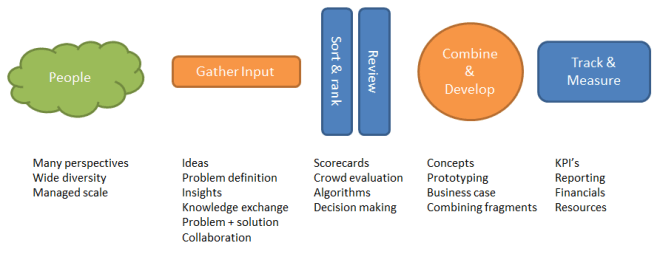
The power of the tool is its ability to handle scale and a distributed workforce, matched with a rigorous way to manage the content generated. But instead of collecting ideas, why not collect insights or problems? Collecting those in a small group of people in the same room can be immensely effective, but being able to do it with ten thousand people across the globe – reaching into areas of the business otherwise isolated from these activities – is potentially game changing.

The first step is to acknowledge that valuable input comes from anywhere in the business, and not just the typical homes of creativity and innovation. For example, why not ask your sales and marketing teams what they are hearing from customers and prospects? These individuals are on the front-line and have some of the best insights into the mind of the customer. The input can be sorted and ranked quickly, and conclusions can spark clear challenges where idea campaigns should be run.

generic-process.png

Defining the problem

Most companies, and indeed individuals, are not short of ideas – but they are often short of knowing exactly where to ideate. As Albert Einstein reminds us, “If I had an hour to solve a problem, I would spend 55 minutes determining the problem, and 5 minutes on the solution”. Once a company knows precisely which problem to target, it typically has all of the necessary ingredients to solve it. Yet it is still not a common practice for companies to use their innovation tools to discover the problem areas on a mass scale.

At the center of any innovation is a coming together of two key aspects: making a problem known and identifiable, and combining fragments of input (ideas, insights, facts) into a single concept. A P&G example shows the potency of this:

“Research showed that about 80% of consumers in India wash their clothes by hand. They had to choose between detergents that were relatively gentle on the skin but not very good at actually cleaning clothes, and more-potent but harsher agents. With the problem clearly identified, in 2009 a team came up with Tide Naturals, which cleaned well without causing irritation … [it] has helped to significantly increase Tide’s share in India.” – Harvard Business Review, June 2011

problem-matrix

Campaigns are an ideal tool for gathering input first, allowing people to suggest broad areas of interest, attach and reference research and data, and highlight known expertise. This input can be quickly sorted into groups, ranked according to suitability or other criteria, and then used as the basis for a follow-up idea campaign. Running these insight campaigns enables companies to generate volumes of rich data which can be mined and searched on an on-going basis, and it also continues to demonstrate openness to the audience, welcoming the perspectives of all employees.

Innovation as a central utility

At HYPE, we have seen clients using their collaborative innovation platforms with this purpose, and in many more inventive and disruptive ways. We are seeing, for example, an on-going increase in the direction of cost saving and continuous improvement. We call this innovating your business, and strongly recommend it because of the fast return on investment – cost saving ideas and process improvement tweaks can often be implemented quickly, which allow the program to gain momentum, and bring sponsors and employees on side.

The biggest challenge and, at the same time the biggest opportunity we have seen, is the notion of innovation as a utility, powered by a collaborative innovation platform. Many companies now have a central team responsible for driving innovation, usually home to the Chief Innovation Officer. These teams are typically small, and not provided with deep pockets of money or resources. However, they have the tools and mandate to make a sustained impact. They promote the use of campaigns to help business units innovate, allowing the sponsors to reach out widely across the business, in a familiar and consistent way. Furthermore, they follow a well managed and structured process for dealing with the input received, and handle the critical follow-up steps.

Central innovation teams can act like a Swiss Army Knife, with an array of capabilities for boosting innovation. With a platform in place and well organized, companies can run frequent large scale initiatives with minimal cost and effort. The innovation team is able to handle a diverse array of requests, from pure idea generation, to process improvements, knowledge sharing, expert identification, needs and resource exchange, to open innovation with partners, suppliers, and customers.

This notion, of going beyond ideas and creating a process to do so at scale and in a reliable way, with a central utility built around it, is the challenge we see companies racing to overcome.

Key Points

  • Ideas are the easy part, seek out more insights, problems, opportunities
  • Identifying problems and gathering perspectives on them leads to innovation
  • The tool offers a generic process for many use cases
  • Companies are innovating their business, not just products
  • A successful platform can enable innovation as a utility for companies

This post was originally published on LinkedIn

Removing the disincentives to participate in idea campaigns

It is common to see on the homepage of innovation management platforms a message from the CEO, or other senior leader in the company, endorsing the tool and encouraging employees to participate and share their ideas. This is a nice message and helps to demonstrate a purpose – however, it cannot be mistaken for permission to participate, which is sometimes the goal. The permission to participate in reality does not sit with the CEO, but instead with middle management, who are the ones really in control of resources. This layer of authority can pose a significant challenge to progress.

The CEO may have innovation and collaboration as a top strategic goal, but middle management may see the world differently – perhaps they have not had the time to see the relevance of innovation to their business unit, nor been given the tools and knowledge to deal with it. For them, the goal is hitting targets and keeping resources focused on the job at hand. Innovation managers who recognise this take steps to educate and inform. Mike Hatrick at Swisslog, a leading logistics company, developed a training program to coincide with the rollout of the new innovation platform. Mike personally travelled to company locations around the globe to conduct seminars on the vision, purpose, and practical aspects of the initiative.

Educate and inform

In the book Unleashing Innovation, by Nancy Tennant Snyder and Deborah Duarte, the authors explain how Whirlpool created an I-Mentor program designed to build innovation advocates that would develop ties within the business, and strengthen the focus on innovation as a company objective. They realised that innovation could not be left to a select few, they needed everybody in the organisation thinking about the challenges and contributing their knowledge:

“The first seventy-five innovators under our new vision were people drawn from around the world … The idea was for twenty-five of the original seventy-five individuals to go back into the business to use the innovation tools in their daily work. The second twenty-five were to run business units that were started based on innovation results, and the third twenty-five were to teach others the tools and skills.”

The I-Mentor program was instrumental in driving a culture of innovation across the business. To navigate the challenge of middle management, education and dissemination of knowledge is essential – a structured program to inform and reinforce the message is key. Whirlpool had the luxury of a major initiative which provided the resources to do this on a large scale and at rapid pace, but as Mike Hatrick has shown, it can also be led by the charge of a single innovation champion.

The standing ovation model

Participating in idea campaigns is voluntary, employees don’t have to read the invitation email, and they don’t have to take the time to contribute. In most cases it is desirable to take part, but the first hurdle to overcome is: do my superiors and peers think I should be spending time on something like this? If this is unclear, how can people be influenced to take part?

An example from Scott E. Page, University of Michigan, provides a useful analogy. What makes people stand up and applaud at a show? Several factors are important, the quality of the performance is of course pivotal. Standing ovations tend to happen spontaneously, the entire audience begins to rise like a Mexican Wave. Page says that the viewpoint of where you are sitting is important:

  • At the back of the auditorium are the academics, they can see everyone else in the theatre, they have a great perspective, but nobody else can see them or what they do – if the back row stands up, it has no impact on the rest of the audience.

  • The middle has the general population. They can see some people in front, and some people behind can see them, so they have some limited influence.

  • But the front row – the celebrities – can be seen by everybody, yet they cannot see anyone else. They are the trendsetters, and if they decide to stand up the rest of the theatre is most likely to follow.

The celebrities sitting in the front row are a small group of people with a large influence over the behaviour of others. Companies work in a similar way, there are key figures throughout the organisation, not necessarily those in top ranking positions, who have frequent and high visibility. Seek out those individuals and aim to bring them on side with your initiative. If this small group is engaged, it could lead to a tipping point as others follow their behaviour. We have seen companies immediately jump into education for the masses, to convince every individual of the importance of taking part – while this is certainly a good thing, it might be more productive to focus on bringing the celebrities on board, and help to create a tipping point in acceptance of the program.

Open to sharing my IP

An engineering company told us of the challenge in getting high quality detailed ideas from their engineers. The reason they found is that the engineers had a great sense of pride in their patents – they were also rewarded for having patents – they are driven by having unique ideas. Engineers would hide their ideas away in a notebook rather than share them openly in a company-wide system. The innovation team had to convince them that putting an idea into the system means a documented time stamp, with author, location, department, and the data is protected and backed-up. The idea is safer and more tightly linked to the original author inside the system than written down in a notebook.

This can be a serious obstacle to overcome in some cultures. Communication should be clearly provided about the reassurances around ideas submitted. In most cases ideas are only fragments of a solution, and rarely a demonstrable piece of intellectual property. But if this is the case it’s recommended to include a patent workflow into the platform to quickly handle those types of ideas. Several HYPE clients have this process integrated, allowing ideas to be flagged and pushed through a separate series of steps which involve the company patent department.

Technical hurdles

The barriers mentioned so far are largely process and cultural in nature, but there is one consistent barrier that came up more frequently than any other: single-sign-on access to the tool. SSO is a simple process to enable, and is typically done in hosted and installed situations, but often the challenge remains in corporate IT departments, where they lack the resources, know-how, or motivation to assist. Sometimes the innovation manager is faced with the choice of getting the platform out on time without the full support of IT, or delay launch until IT can provide the necessary assistance – as one client told me:

“Biggest barrier? Single-sign-on – to reduce the barrier for users to get on board. At the time there was so much IT change going on, that it was hard to get it sorted. In hindsight I would probably have delayed the whole rollout by a year just to ensure this was sorted.” – Mike Hatrick, Innovation Manager at Swisslog

Similarly another client in a different industry also mentioned this:

“Not having SSO in place yet – this is the biggest barrier to adoption. Users love the tool, they love the spirit of it, but they don’t have time to find their credentials every time. Either quickly log me into the tool during a coffee break, or I probably won’t bother.” Innovation Manager at Aviation Company

Today many companies are deploying social business platforms to replace legacy intranets, file sharing repositories, and discussion forums. If implemented well these social tools can be an excellent hub for activity. It’s important that your innovation platform integrates with them, so that users can seamlessly move between the two systems. Deep integrations can provide significant benefits, and reduce barriers to entry. For example vendors like HYPE (probably others too) are able to display widgets within the social tool which display real-time data from campaigns, and even allow the setup and launch of campaigns natively within the social tool, facilitating data synchronisation back and forth. This means users can choose to participate from either side – and innovation managers can still utilise the full benefits of evaluations, analytics, reporting, and pipeline management.

So while there is a lot of focus on incentives and motivation to participate in online platforms, big corporates should still take a good look at the disincentives and remove as many of those barriers as possible.

Key Points

  • Permission to participate mostly sits with middle management

  • Educate and inform key individuals in the business about the goals

  • Company celebrities can help you build momentum if they are on board

  • Tackle IP concerns up front with the community

  • Single-sign-on is a major hurdle to user acceptance

How to handle rewards and motivation in idea management campaigns

Rewards are often considered an essential part of idea campaigns, it seems natural to give out prizes to those people who submit breakthrough concepts. After all, people have a choice whether to share their idea, nobody can force them to spend time in the system, and willingly give over their intellectual property.

However, rewards are a complicated topic, they can have short term effects on participation and interest levels, generating excitement – but they can also have severe detrimental effects on the long term health of your program. For example, a client of ours in a services industry started their initiative with substantial tangible rewards, including cash and holidays for winning idea authors. These rewards had the desired impact at first, but over time the focus on rewarding ideators meant that commenting and collaborating dramatically declined. People only saw value in the idea submission. Subsequently, they decided to stop issuing rewards – the result was a lack of interest in the program altogether.

The substitution effect

This problem summarises the biggest warning we’ve discovered with rewards – if you put them in, you will struggle to take them out. In psychology this is known as the effect of substitution; one experiment helps to clarify the problem:

A group of children were given ten minutes to freely paint pictures, most of the children enjoyed being creative, and a handful found it boring and did not fully engage – as you might expect. Next they told the children that they would receive rewards for their paintings, a gold star, a chocolate, etc. They ran the ten minute exercise again, and had similar results. Finally, they took the rewards away, and ran it for a third time. Now, even those children who were originally highly engaged became less engaged, and produced less creative paintings. The act of painting itself was the motivation for the children – but after being rewarded for it, the pleasure has been substituted for the reward, and when the reward is taken away the original interest had declined. This substitution effect has been seen in many similar experiments in both adults and children.

The challenge lies in finding the right balance between intrinsic and extrinsic motivations, and in directing rewards towards the most relevant areas of the process.

Intrinsic motivations

Intrinsic motivations are those which are not controlled by external factors, but stem from an innate desire to act. Dan Pink, in his book Drive, describes three primary categories of intrinsic motivators: autonomy, mastery, and purpose.

  • Autonomy – having the freedom to choose how to tackle a task or challenge

  • Mastery – to become better at something, develop confidence and expertise

  • Purpose – to be aligned with a common goal and vision

Participants have a good deal of autonomy when it comes to online ideation campaigns – they don’t have to take part, and if they do, they can often choose when and to what extent to do so.

Mastery can lend itself well, allowing employees to learn from the interesting contributions of others, and to engage with experts from around the company. To have your idea developed by others, or to see it implemented, can be a tremendous boost to one’s confidence about their own ability and reputation.

Purpose is a strong driver within collaborative innovation, and it can be seen in the following examples:

  • The company has a clear vision and purpose for the ideation – there is a shared goal to which everybody is aligned. If this purpose is worthy, engaging, and in harmony with the individuals, it can be a powerful driver.

  • A desire to solve problems. Many individuals are strongly motivated to figure out a solution to a difficult problem. Idea campaigns are an ideal way to tap into this motivation and create a compelling sense of purpose.

  • A desire to help others. A sponsor who is well known and respected can drive engagement by asking for help. Ideas from fellow employees can drive collaboration and lead to stronger concepts.

In most organizations the culture is such that intrinsic motivations are enough to build and sustain momentum. It is recommended to try to avoid the use of rewards at first, and seek to find these inherent levers which engage people, such as those mentioned above, and additionally:

  • fun mascot for branding can create an identity for the program. It’s important to make it feel welcoming to employees, while also demonstrating a willingness to consider ideas seriously.

  • Make use of key sponsors who have a reputation for getting things done, and garner general support from the employee base.

  • Be consistent with follow-up, don’t allow cynicism to develop.

  • Celebrate successes, communicate them frequently, and recognize the participation of everybody.

“Are rewards important? Not really – something else motivates you to get involved. A reward is just a nice after effect. What people really want most is feedback about their ideas, what happened, where did it go, is it being actioned by somebody?” – Innovation Manager at European Engineering Company (HYPE Client)

Where rewards make most sense

When implementing rewards, consider first where they are most needed.

The job of submitting ideas is already preloaded with strong motivation – most people want to put their ideas into the system given the chance to do so. Commenting however can sometimes be seen as a less appreciated activity, but is just as critical for success. Rewarding frequent and constructive collaboration can encourage the right behaviors in the community. Evaluating ideas is also seen as a less glamorous task, but is key to developing ideas and concepts which can traverse the innovation pipeline. Similarly is the task of implementing ideas, which is where ideation truly meets innovation. One client told us of how they reward both the ideator and the implementor equally each month – typically they are not the same person, but they are both part of the story.

Dan Pink cites examples where rewards have a negative impact on creative tasks, but for routine and repetitive work rewards can boost performance. Reviewing is often seen as a bottleneck in the innovation process – reviewers struggle to find the time, ideas can be complex to properly evaluate, and the volume is sometimes overwhelming. If there is one part of the process that is most congenial to extrinsic rewards, it might be the evaluations.

“Creativity-supporting organizations consistently reward creativity, but they avoid using money to ‘bribe’ people to come up with innovative ideas. Because monetary rewards make people feel as if they are being controlled, such a tactic probably won’t work.” – How to Kill Creativity, Harvard Business Review, Teresa Amabile

Unexpected rewards pose less risk

Rewards which are expected have the most potential for damage – cash prizes for the winning ideas, for example. Unexpected rewards can have a positive impact however, with less risk. A European logistics client of ours has experimented with giving random rewards to boost interest, by contributing a comment to an idea in a campaign you’ll be entered into a draw for a prize at the end. For an employee it’s a matter of simply being in it to win it – a relatively small hurdle – but once in the system the hope is that ideas and contributions will spark more interest and drive more engagement. Tactics like this can be helpful to simply fuel awareness and get people moving into the campaigns.

Key Points

  • Once rewards are in place it can be hard to take them away

  • Avoid substituting the intrinsic motivations with rewards

  • Rewards can work best on the less glamorous tasks like commenting or reviewing

  • Intrinsic motivations stem from autonomy, mastery and purpose

  • Monetary rewards can make people feel they are being controlled

Campaigns are the driver for idea management success

In a recent Booz & Company study it was reported that only 40% of the 1,000 most innovative companies have a structured idea management program in place (The Global Innovation 1000: Navigating the Digital Future). A surprising fact given the importance of idea generation in the innovation process. This means that 60% of the biggest and best companies in the world are still using archaic methods to collect, organize, and manage ideas. Whether it be offline in face-to-face brainstorming sessions, using email, excel spreadsheets, open suggestion boxes – or ultimately, no idea gathering at all.

Even for those companies that do have an enterprise-wide idea capture tool in place, Booz & Company reports that there is general discontent about the effectiveness of these programs. There are many reasons for the poor return on investment which we explore in a white paper, but the obvious starting point is the campaign methodology.

The structured campaign methodology

Many companies still try to launch an idea program in the old fashion way – like a suggestion box: ideas of any kind are dropped in from across the business without a clear problem statement defined. A good marketing splash can make this work for a short time, but it’s not sustainable.

Campaigns allow you to focus on the areas of the business that you want to innovate in right now. By defining a clear topic you improve idea quality, which in return increases the probability that they actually get implemented. Showing an innovation pipeline with ideas moving through to implementation builds trust and momentum with the audience. Campaigns by definition have a given time frame, and sometimes target a specific audience – both of these help to focus the right amount of corporate energy on the best possible outcomes.

With a campaign approach you can begin to think strategically about your efforts. Define the hunting grounds where you want to find ideas, then map out a series of campaigns to tackle those areas.

We find that the most successful companies have a balanced approach to running big strategic challenges, interspersed with tactical ones. Tactical ones, such as cost saving or process improvements, can generate ideas which can be implemented quickly and allow innovation managers to show results. This is both advantageous to innovation managers and sponsors, but also critical for momentum within the audience. Strategic campaigns have a longer timeframe, and often the ideas must be combined and taken through a concepting phase before real opportunity can be identified. If there is a clear roadmap of activity in both areas, the program is more likely to grow in adoption and becomes sustainable as a process.

The myth of missing big ideas

There is sometimes the feeling that always-open suggestion boxes must be available just in case a big idea comes along. This is largely a myth. Ideas themselves are almost always just a fragment of an innovation – they must be developed and built upon from several sides before they can be made into something valuable. It is more productive to first demonstrate that as a company you are open to ideas from all areas, and you will follow-up on them. Campaigns are a more reliable way to build this trust, and if you achieve this it’s more likely that breakthrough ideas will find their way into the process. The alternative, of having an always open suggestion box can lead to skepticism when ideas linger and do not find their way into a project.

Why not have both? This is the option some companies have taken, for example, a global logistics firm we spoke to is running frequent campaigns but also providing a 24/7 365 space for unsolicited ideas. This can work if you ensure you have momentum developing in the other areas, and if you have a structured approach to dealing with unsolicited ideas. The company has a review process every eight weeks to look at all unsolicited ideas, and either close them as not useful right now, or route them to an owner who can develop them further. This kind of rigor is not simple, and it will consume significant time from an individual who needs to be well connected and know how to push ideas into the right areas of the business.

A South American client in the financial services industry runs campaigns in each of the eight countries it covers. Every year they survey the countries to measure the perception of innovation from the employees, and whether they feel part of the innovation process. In the countries that run frequent and systematic campaigns, they have a higher statistic on these survey points.

Campaign leader kits

Companies that take the campaign process seriously have begun to develop campaign kits – a kind of education pack which enables sponsors and administrators to follow a guided process for launching and managing their campaigns. A European engineering company found that sponsors often want to just start and run something immediately, and underestimate the work involved. The first step towards improving this is an interview with the sponsor, where they are asked to define the problem, decide how much investment they will provide for winning ideas, allocate time for people to run the campaign process, and define the criteria for judging ideas. If these steps are not fully explored the campaign does not go ahead.

“If you are unprepared as a campaign leader, it is quite certain that you will fail.”
– Innovation Manager, European Engineering Company

A campaign questionnaire is a good starting point for developing these leader kits, but it needs to go further into the specifics of communication. For example, showing details of past campaigns – what worked and what didn’t – can serve as inspiration for new sponsors. It is recommended that innovation teams keep a workbook of every campaign, listing hard factors about participation and outcomes, along with soft factors such as the written communication and word of mouth feedback from participants.

Key Points

  • Define the high level hunting grounds for new ideas

  • Balance your campaigns between strategic and tactical

  • Cost saving and process campaigns help to build momentum

  • Always-open suggestion boxes can create skepticism

  • A campaign leader kit helps to create a consistent approach

This article was originally published on the HYPE Innovation Blog.